
| Installing HF Radio on board our boat |
| Previous Tip | Home | Next tip |
|
Installing HF Radio on board without cutting the backstay and without drilling a hole in the hull
We bought an ICOM 706 MKIIg, Pactor III modem and AT4 antenna tuner in our very first season and carried it with us to the BVI. The Pactor III modem is required only if you need email but it is also helpful for retrieving radio fax. We had already worked out the software:airmail for email and jvcomm for weather fax at home. The cabling between the radio and the TNC (radio modem) is arcane and we got pre made cables from HF Radio on Board in Alameda as well as the TNC and a lot of good advice. I had had a ham radio license since an early age and a HAM radio was a clear choice for us. It costs about half what an Marine SSB Radio costs and it has a tuning dial which all geeks prefer to the "user friendly" push button Marine SSB. We also made a small modification to allow this HAM radio to transmit on Marine SSB channels.We have not had occasion to operate the transmitter on SSB (which would not be strictly legal) but thought it would be good to have the capability to do so in case of emergency (which is legal). If you do not have a HAM license from the FCC, you must buy a Marine SSB and use a pay service for the HF Email but the following installation advice will be similarly applicable. Marine SSB has a great deal of lively traffic and will be a lot easier to operate in case of emergency. Get a license (no exam required) from the FCC. Standard advice for installing a HF Radio on board your boat involves two big steps:
This is the way professionals will install your radio and it will involve a haul out to drill holes in your hull and a rigger (to cut the backstay and install the insulators). This sort of installation will not exhibit individual variation among boats and is therefore a good choice from the point of view of the installer. The dynaplate does not make a particularly effective counterpoise for the antenna but the recommended copper foil is marginally effective. I may be a radio geek but I am a sailor first and weakening the standing rigging or putting holes in the hull are not something I can do casually. Furthermore, I am a cheapskate and prefer to spend my money on the toys and not the experts. The following advice was given to me by an electrical engineer only after I had satisfactorily answered the following questions:
The risk in this method of installation is that you might have a passenger or crew member holding on to the rigging while you are transmitting. I have not actually performed the experiment but I believe that it might result in a burn depending on the frequency and duration of your transmission. But what do I know? I am not an electrical engineer. I am not a lawyer. You are not paying for this advice. Use at your own risk! Not to be used as a personal floatation device. Not intended for human consumption & so on. The cheapskate sailor's HF Radio Installation The notion is to use the whole rig as a kind of antenna known as a delta. If the mast or the standing rigging is not electrically bonded to toe rail or to the boat ground and your boat is plastic (fiberglass), the entire rig can be used as "the antenna". . We ran high voltage wire (insulated somewhat like spark plug wire) from the tuner "antenna" lug to the bolts projecting through the transom from the chainplate of the backstay inside the stern lazerette on the starboard side near where the tuner is installed. Before you do this on your boat, make sure that the backstay is not electrically bonded to the toerail. A simple ohm meter will tell you if the standing rigging and the toe rail are bonded. A better name for this portion of the antenna system is "the counter poise ". The signal needs to push off of something. In a dipole, the ground does not play a role because the two halves of the dipole push against each other. A whip (this is the long white antennas sold by Shakespeare) works like a dipole antenna mounted vertically with some other conductive body serving as the other half. If you have a metal boat - you will have a great signal because you have such a great counter poise for the signal to push against.. The "ground" side of the antenna tuner is attached to hull and the signal (antenna) side is attached to a whip at least 23' long. . If you are on land, you can bury wires radiating out from the pole, place wire mesh around the base of the antenna or place the whip in the center of your mobile home (or other metal structure) If your boat is plastic (like Eaux Vives) , you must supply the counterpoise. Alternatively, you can go to an antenna design that has both radiating element and counterpoise up in the air. None of these designs seemed practical at the wave lengths we are using. Ideally, you would install a copper mesh inside the hull and use that as the counterpoise. You can buy one or more Dyna plates and mount them outside the hull. Dyna plate will tell you some hocus occurs about activated nodules replacing a huge spread of metal under the whip with a little 20 square inch shoe in contact with the sea water. It will work but not much better than throwing a little bit of copper foil overboard. We did that the first season and it worked fine. The sea is an adequate but weak counterpoise. It is also messy and very hard on the copper foil which immediately begins to corrode. Some have tried bonding the ground to a metal through hull and this seems to work ok. My concern is in the potential for corrosion around the through hull. On Eaux Vives we used metal already on the boat which was already in the right spot. We run the traditional heavy copper foil from one toe rail at the stern of the boat, across the antenna tuner "ground" lug and to the other stern end of the toe rail. Before deciding on this method, I checked with a Multi-meter to see that there was no short between the toe rails and the standing rigging. It was while doing this that I found that the two toe rails (port and starboard sides) were not bonded. The foil running across the back of the boat also presents some more area of counterpoise. A branch of this foil also goes to my metal fuel tank which lies aft between the two toe rails. As an aside: If you are ever in a position to influence boat builders (or are building your own hull) ask for a copper mesh to be embedded in the hull itself. The copper lying around in the boat is a constant source of corruption.
The New Improved! Delux Installation Since this was written, we have purchased a new boat, Queen Emma which came equiped with a Marine SSB from ICOM, the M710. The boat had a back stay which already had insulators installed. It also had a dynaplate on the hull and so was a standard installation. Unfortunatly everything was non-functional. Saltwater had leaked into the radio. the tuner control wiring was incorrect and the ground strap from the tuner to the dynaplate was corroded away as was the connection between the tuner and the backstay. ICOM took the radio in and swaped in a new motherboard. HF Radio on Board modified it to allow for effective use on Ham bands and I set about fixing the installation. After cleaning up the green crumbs which were all that remained of the copper foil comprising the ground strap, I didn't want any more copper in the bilge. Instead I am using a KISS SSB ground plane system. The dyna plate is just hanging on the hull waiting for the next haulout to be removed. The KISS SSB has about a four foot long, insulated length of wire into an approximately 12 foot tube 1" in diameter. The tube contains tuned elements for the common frequencies and is wiretied in a loop just under the aft birth. The tuner is at the head of the berth and the connections are all made just under the the bed probably 2 feet above the water line. No exposed copper. No more yelling out warnings when about to send email. Excellent signal reports. Recommended. |
| ©2002-6 Accidental Cruiser | Home • Islands • Photo Journal • Cruising Log • Sailing Info • Viewer's Comments • Comment |
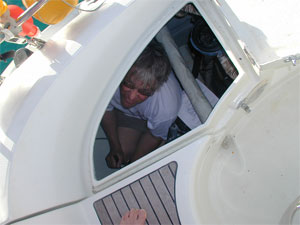 Through radio we have met a great number of friends and become a part of the community. We get advice, weather information, find old friends and meet new ones through the radio. Whether Ham radio or SSB, the short wave radio is the only reasonably reliable form of communications on board over the horizon. You can get a very slow email service but one which has truly global coverage. Cell phones work only when near the towers and we finally dumped our Globalstar sat phone because it was so flaky in the southern Caribbean. Furthermore, cell phones and sat phones do not have the more social properties of the party line. When inquiring about the weather up island, an acquaintance in your own anchorage can break in and invite you over for sundowners.
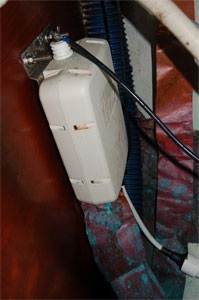 Basically the modern antenna tuners can match a dull axe to your transmitter and make it serve as an antenna. The real difference between installations is in the "ground". The ground is actually a counterpoise which serves as a phantom "other half" of the antenna for the signal to push off of. It is probably best to get an antenna tuner that matches your radio, not a manual tuner. This tuner comes from ICOM and has one coaxial cable bringing the signal and one control cable for the radio to cause the tuner to tune the antenna to the current frequency of your radio. Ones from SGC do the tuning off the broadcast signal and don't require the control cable. The other connections are a ground strap to the "ground" (discussed below) which is the slightly corroded copper strap attached at the bottom and seen in the background climbing up to the bolts holding the toe rail on the hull The antenna is connected at the wing nut at the top and is the dark, round, single conductor high voltage wire passing to the right in the picture over to the chainplate of one of the backstays. The box itself is mounted on the aft side of the aft bulkhead of the starboard side cabin. This tuner has been sitting in the rather damp aft lazerette for 5 yars in the tropics and has only needed replacement of the antenna feed which corroded through.
 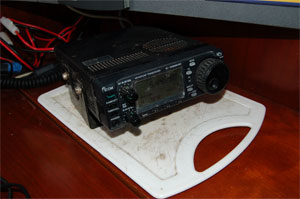 I mounted the radio on a well-used cutting board to which I applied non-slip matting. This not only avoided making a square hole in the nav station's power panel, it also put the knob in a position more comfortable for me to operate. As my panel is at right angles to the seat, mounting it in the panel would have had me twisting to one side to see the dial. Be sure to use very heavy power cable from the radio to your batteries. Poor signals seem to commonly result from excessive voltage drop in the power supply cable. This little unit is fantastic. No complaints, many kudos to ICOM.